


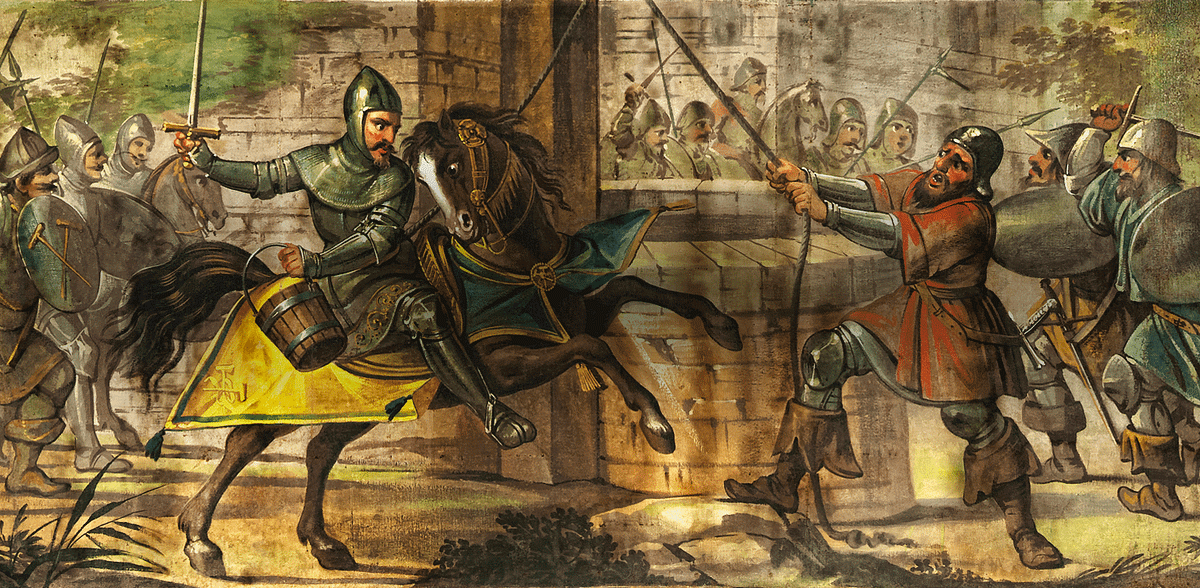
We like to think wars happen because of profound disagreements, ideological clashes, or battles over resources that shape the course of history.
Sometimes they do, but other times, someone loses an argument over a bucket, an ear, or a pastry shop, and before you know it, governments are mobilising troops.
History has a funny way of reminding us that countries are, ultimately, just collections of people. And people, regardless of how many flags or tanks they possess, can be unbelievably dramatic.
1. The Great Emu War (Australia vs. Birds, 1932)
I wish this is a joke but it isn’t.
In 1932, Australia endured an ‘infestation’ of around 20,000 emus. They descended on farmland, demolishing wheat crops and punching holes through fences, helpfully allowing rabbits to join the destruction. The farmers, many of whom were veterans of the First World War, decided they’d had enough and requested military assistance. The Australian army responded with machine guns, which seemed reasonable at the time.
Unfortunately, nobody informed the emus. Instead of charging dramatically into gunfire like cooperative movie villains, they split into smaller groups, scattered in every direction, sprinting at nearly 50 km/h, and proved annoyingly resilient even when hit. After six days, thousands of bullets had been fired, very few birds had been killed, morale had collapsed, and the military quietly withdrew.
A country declared war on wildlife. Wildlife won. Only in Australia, I guess.
2. The Whisky War (Canada vs. Denmark)
If every territorial dispute worked like this, geopolitics would be far more pleasant.
For decades, Canada and Denmark argued over Hans Island, a tiny, completely uninhabited rock. Instead of missiles or sanctions, each side would visit the island, plant its flag, remove the other country’s flag, and leave behind a bottle of alcohol. Canada left whisky. Denmark left schnapps. The other side would return a few months later and politely do the same.
This went on for years before both countries finally agreed in 2022 to split the island peacefully. Somewhere in all of this was presumably a very confused official whose job involved restocking alcohol on a frozen rock.
3. The Pastry War (France vs. Mexico, 1838)
You know a complaint has escalated when it ends in a naval blockade.
A French pastry chef living in Mexico claimed that Mexican officers had looted and destroyed his bakery. He demanded compensation of 600,000 pesos—an amount so ambitious it feels bold even by modern standards. Mexico refused.
France responded exactly as calm, rational nations do: King Louis-Philippe sent warships, blockaded Veracruz, seized Mexican vessels, and started a war. All over a bakery bill. Never underestimate a Frenchman’s commitment to pastry.
4. The War of Jenkins’ Ear (Britain vs. Spain, 1739)
Some people hold grudges. Others curate them.
In 1731, Spanish coast guards boarded the ship of British captain Robert Jenkins on suspicion of smuggling and, during the encounter, allegedly sliced off his ear. Jenkins did not move on with his life. Instead, he preserved the ear in a jar.
Eight years later, he presented it to Parliament like Exhibit A in a courtroom drama. Parliament collectively decided this was now everyone’s problem, and Britain declared war on Spain. Captain Jenkins didn’t just hold a grudge; he preserved it for future use.
5. The War of the Bucket (Bologna vs. Modena, 1325)
The name alone deserves recognition.
Popular legend claims the war began because soldiers from Modena stole a wooden bucket from a well in Bologna. In reality, the bucket was taken after the battle as a trophy to mock the defeated city, while the actual causes involved centuries of political, religious, and territorial tension.
History, however, chose to remember the bucket. It turns out some PR victories last longer than military ones.
6. The Football War (El Salvador vs. Honduras, 1969)
Despite the name, nobody invaded over a bad refereeing decision.
The conflict occurred during a heated World Cup qualifying series, but football was merely the spark. Years of tension over immigration, land ownership, and population pressures had already pushed relations to breaking point. The matches simply gave both sides a convenient excuse to explode.
It’s a useful reminder that history usually has far more context than the headlines suggest.
7. The War of the Golden Stool (Britain vs. the Ashanti Empire, 1900s)
Sometimes arrogance meets a very firm line.
The British governor demanded permission to sit on the Golden Stool, assuming it was just a ceremonial throne. Unfortunately for him, it represented the soul of the Ashanti nation. As you might expect, this request did not go down well.
The demand triggered a full-scale uprising. Britain eventually crushed the rebellion… but never got the stool, which was very much the point.
8. The Hundred-Year War That Wasn’t (Líjar, Spain vs. France, 1883–1983)
Proof that grudges can outlive generations.
After reports that France had insulted the Spanish king, the tiny village of Líjar declared war. Then nothing happened—for an entire century. No battles, no casualties, no campaigns, just a remarkably committed refusal to let it go.
In 1983, someone finally decided everyone had probably calmed down enough, and peace was declared. Some conflicts aren’t about fighting; they’re about never admitting you overreacted.
9. The Volvo Scam (North Korea vs. Sweden, 1970s)
If unpaid invoices were an Olympic sport, this would be gold.
In the 1970s, North Korea ordered 1,000 Volvo sedans from Sweden as part of a trade deal. Sweden delivered every single car. North Korea never paid.
More than fifty years later, Sweden is still sending invoices to Pyongyang with the quiet optimism of someone following up on a message that’s been ignored since the Cold War. With decades of interest, the bill has ballooned into hundreds of millions of dollars.
Considering that this was done to Bangladesh and other countries as well, this isn’t just ghosting a creditor, it’s turning non-payment into foreign policy.
History often reminds us that nations are powerful, sophisticated institutions. It also quietly reminds us that those nations are run by people. And people, given enough time, are perfectly capable of starting international incidents over pastries, wooden buckets, preserved ears, sacred furniture, unpaid Volvos, and birds with better military instincts than trained soldiers.
Sometimes the strangest part of history isn’t that these things happened.
It’s that every single one of them is true.


