


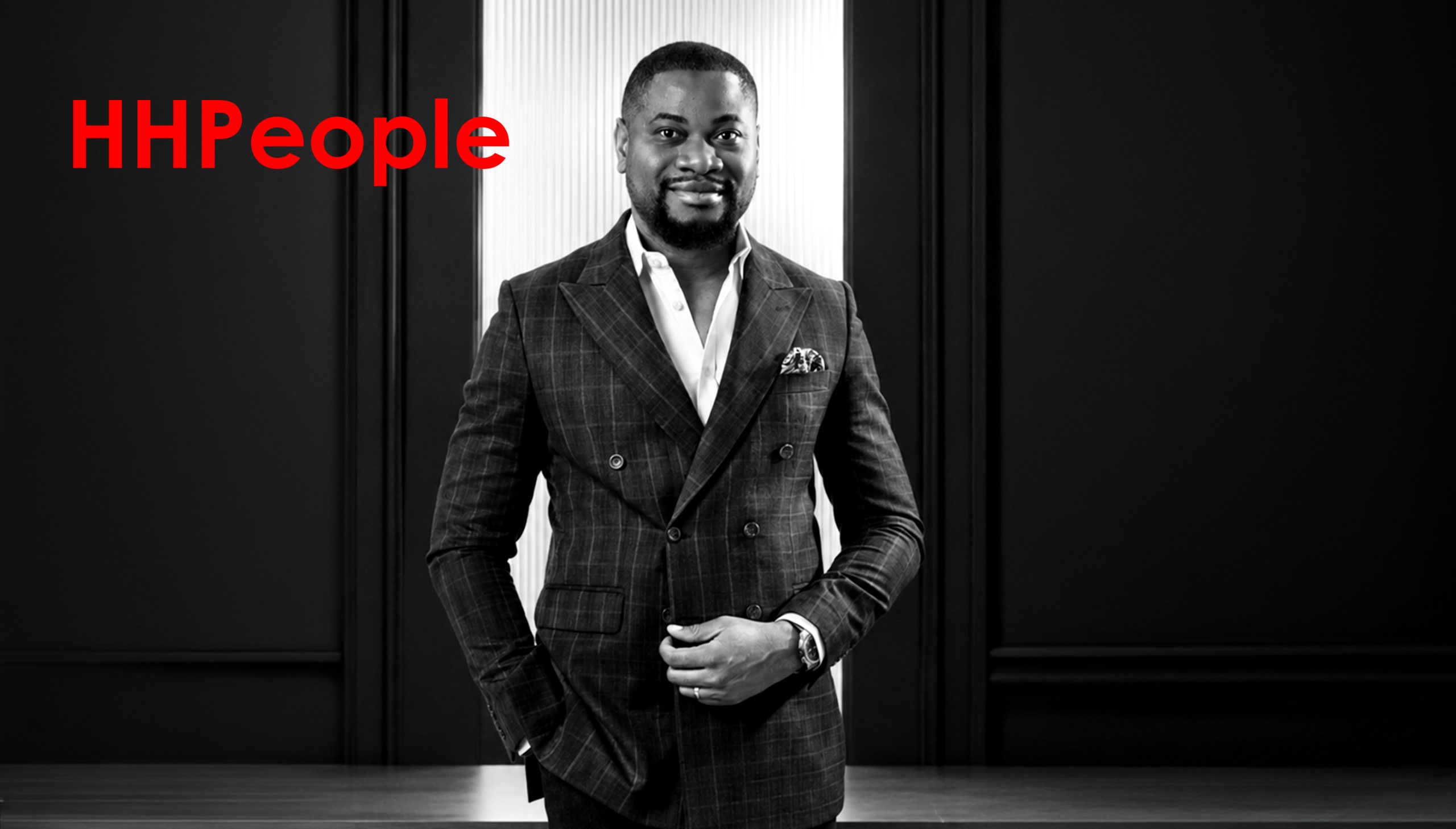
There is a certain kind of honesty that only comes from men who have lived enough life to stop performing it.
In this conversation, Nnamdi Azubuike speaks thoughtfully about fatherhood, responsibility, vulnerability, ambition, partnership, and the evolving idea of what it means to be a man today. What emerges is not a rigid definition of masculinity, but something more balanced and human, a reflection on leadership, emotional strength, accountability, and the quiet lessons passed down from one generation to the next.
From memories of a father whose word was law to his thoughts on marriage as a partnership rather than performance, Nnamdi’s perspective is shaped less by grand declarations and more by lived experience. Throughout the conversation, one theme keeps resurfacing: responsibility, not as a burden, but as the foundation upon which meaningful manhood is built.
In this edition of HH People, he speaks with Chinwendu Ogbechie about the men who shaped him, the lessons marriage teaches over time, the balance between strength and vulnerability, and why younger men today may finally be redefining masculinity in healthier ways.
CO for HH People: Who taught you the most about manhood, intentionally or unintentionally?
NA: That is a very deep question. I need to think about it.
Growing up, I was quite close to my dad, and everything my dad embodied, I wanted to be like. My dad was a banker for decades, so the nature of my decisions in early adulthood, especially in terms of the career I wanted to pursue, was essentially informed by what my father was.
He was a banker, and he used to dress in very nice, crisp suits. When I say early adulthood, I mean from JSS, Junior Secondary School, when questions started coming up about what I wanted to do with my life. The way I answered that question was: what course do I need to study to be like my father?
There was economics, finance, and accounting. I just knew I wanted to do something connected to maths. I was good at maths in school, so I wanted to do maths for business. Business maths. The closest course to that for me was finance. That is how I studied finance and why I eventually came into the field.
To answer the question specifically, my father shaped that mentality of what a man should be: a provider, a figurehead, etcetera, etcetera.
It was my father. My father. My father.
My father was also a man whose yes was yes, and whose no was no. If my father tells you yes, it is yes. More importantly, if my father says no, he knows how to say no. His no is clear, irrespective of whose ox is gored.
I used to call him a man for all seasons because of my early interest in literature. There was a book I read, A Man for All Seasons. I think it was by Robert Frost. That was what my father was to me. He does not cut corners. He is stern. Yes is yes. No is no. “I will not do it” means “I will not do it.” “I will do it” means “I will keep to my word.”
So, my father. My father. My father.
CO: What does being “a good man” mean to you today compared to what you believed growing up?
NA: I think the keyword is responsibility.
There is no standard template for this, but what is clear to me is a sense of responsibility. Compared to when I made my first buck, what has essentially changed is my sense of responsibility.
It is now more like: the kids need to be okay, the kids need to be fine, the family has to be fine, and everything is less about me. The focus has shifted from myself to the people I am responsible for.
So, I guess the key differentiating point is responsibility. I do not think of responsibility as something that weighs a man down. I think of it more in terms of where you channel your resources the most.
If I think of my resources as a pizza, it is less about cutting the biggest section for myself and more about making sure enough of it goes to my family. That is where the sense of responsibility comes in now.
The sense of responsibility you have as a single guy, when you are catching cruise from Friday night to Sunday, is very different from the responsibility that comes with having a family.
It is also about understanding that you are a role model to the people in your home. Your family is looking up to you to set the pace and the tone for almost everything in the house.
So, for me, responsibility is both a verb and a noun.
CO: A lot of men become providers before they become emotionally expressive. Was that true for you?
NA: I guess that is the strength of having a partner.
The way I have always approached the idea of starting a family is that it is about building something with somebody. To build something with somebody, you have to be expressive. Otherwise, the person cannot truly build with you. A lot of it also comes down to vulnerability. You have to be vulnerable.
The way to mentally separate it is this: at work, or in business, you often have to come in with armour. People see you as strong, capable, composed, and in control. At home, your partner probably sees you differently, because home is where you are allowed to be vulnerable.
So, I think it is a fine blend of wearing the armour in the workplace to provide, then going home to your comfort place, where you can be vulnerable and expressive.
That vulnerability also helps you. It fortifies you to go back out. Where you need to show strength, you show strength. Where you need to be vulnerable, you allow yourself to be vulnerable.
I do not think it is cast in stone. I think you just have to assign each situation the right attributes needed to get the right outcome.
For me, one key feature of a working relationship is the ability to be vulnerable with your partner. If I do not think I can be vulnerable and expressive with you, then I do not think we should be in a relationship, or even a situationship, in the first place.
CO: So, it is not about being a provider?
NA: Anybody can provide. At the end of the day, it is not always 50-50. You also have to clarify what provision actually means.
A lot of people think provision is only about putting money on the table and making sure everything runs. That is not all it is. There is emotional provision, spiritual provision, and financial provision.
If I look at the way our roles are divided, especially with the more routine emotional and spiritual presence, it depends on the couple. Some couples may want to be very structured about it, and different couples will have different roles. But I can speak to the way the roles are divided for me.
As a man, you set the tone for how almost everything falls into place. You create the frame and the spirit of the home. For example, with spirituality, you set the tone: we are a family that believes in God, we trust God, we love God, and we pray frequently.
My wife, my partner, is often closer to some of those daily needs: the spiritual needs, the emotional needs, and so on. I may be more present in the financial aspect. So, it is not always 50-50. Sometimes it is 60-40. Sometimes it is 70-30. You may find that when I am on holiday, I pray more with the family. But on regular days, my wife prays with the kids almost every day before I come back.
So, it is not cast in stone. Pick your pick.
CO: What is one lesson about fatherhood or mentorship you had to learn the hard way?
NA: I will say something.
Growing up, whenever there were issues between my parents, my mum always seemed right in the first instance. But eventually, when you began to see your father’s perspective, you would understand that he was not bad after all.
There was something my dad used to say in Igbo. He would say that when a mother and father are fighting, and the mother tells you her side of the story, you may immediately say, “Bring Dad, kill Dad. Bring Dad, kill Dad.” I am saying it in English because he usually said it to me in Igbo. But when Dad dimensions it in a way that you understand, you begin to see the balance.
So, I guess one thing you have to learn the hard way is patience.
You have to learn that marriage is one of the biggest forms of a merger between two different people. For that merger to work, it takes time. I do not mean patience as an innate attribute, because you can rationalise that. I mean patience with the institution itself. It gets better with time. That is the element of patience.
There are so many things you will learn. I do not want to say there is only one thing I had to learn the hard way. There are so many things I had to learn the hard way, but being in the situation to witness that learning has helped me.
So, I would tweak it a little. You have to be in the institution to learn the things you have to learn, but I do not always consider them learning the hard way. I see it more as the natural process of being there, staying committed, and continuing to make it work.
I am not speaking as someone who has done it for decades.
CO: Do you think men are truly allowed to be soft, or only when it is convenient for others?
NA: I think it is a weird question because, again, you have to take people’s backgrounds into consideration.
The way I was built and the way I grew up, I grew up in an environment where strength and resilience were highly valued, and where vulnerability was often expressed more privately than publicly. Because every day, whether you like it or not, as the head of the family, everybody is drawing strength from you: your wife, your kids, everybody.
You are allowed to be vulnerable, but you need to know how to manage that vulnerability. No one is really going to teach you how to do that.
So, I will just leave it that way. You need to know what works for you, and you need to have an outlet. For some people, it is football. For others, it may be something else entirely.
CO: What is something younger men today are getting right that older generations often overlooked?
NA: I think a lot of them are getting away from their high chairs and high horses, and they are beginning to see roles as complementary. They are doing that quite well. I do it.
There are many things our forefathers did from their high chairs that meant their wives could not be expressive. It was always cast in stone: this is what a wife has to be, this is what a mother has to be, this is what a woman has to do.
But sometimes, bro, you do the dishes.
You move away from the concept of a man as a provider only, a provider of financial resources, to someone who can work with his wife to keep things going in the house.
So, it is about complementary roles, rather than simply saying, “I am the provider, and every other thing is not my business.”
I think our generation is embracing more inclusion on the home front, rather than holding on strictly to defined male and female roles. That, for me, is one thing young men today are getting right.
CO: Have you ever had a moment where someone looked up to you and you realised, “I need to lead more carefully”?
NA: Life has happened fast for me, to be honest.
Sometimes my kids call me “Dad,” and I still look around like, “Who is the dad?” They just line up, and I am like, “You three? Who are you guys crying to now? Who will I cry to?”
But I guess the person who puts me in check a lot is my wife. She is very clear, not about what an ideal man should be, but about what we call non-negotiables.
When you look at the non-negotiables, you have a very clear sense of what you can and cannot do for this partnership to keep going. I do not always refer to my relationship as marriage. I think of it more as a partnership. So, it is more like having heads of terms that you should always work within. That creates a natural gatekeeping perimeter for me.
For example, as a single guy, I could party. I enjoyed that phase of my life and was very socially active. But now, if I go out, I have to state clearly where I am going. If I tell her I am going to two clubs tonight, there is no problem. I can go. But if, for any reason, there is an unplanned third club, I owe it to her to let her know.
“We are leaving Vaniti, and we are going somewhere else.” That is accountability.
So, in terms of whether there have been moments where I have been put in check, or where I have had to look back at what is absolutely constant, it always comes back to those principles: the non-negotiables that allow the partnership to keep going.
There are a number of them I have had to think through again, especially when it comes to religion. For instance, in my house, for a long time, there was an expectation that we always had to go to church. Over time, I have had to find a more balanced approach. I do not think it always has to be rigid, especially because I have become more particular about the kind of church environment I want to be part of.
So, at the end of the day, you have to find the balance.
CO: What does emotional strength look like in your opinion?
NA: Emotional strength is the ability to cry when you need to cry and the ability to shout when you need to shout.
There is no real strength in suppressing emotions forever. Emotions have to be let out as quickly as possible.
So, for me, it is the ability to cry when you want to cry, if you cry, and the ability to shout if and when you want to shout. That is the first strike.
If I look at the question again, when you are angry, maturity and emotional intelligence teach you to be able to walk away. So, the second layer is the ability to walk away when you are provoked, but that is cliché.
For me, it is simple, especially as it relates to sadness. Many times, men bottle things up, and I feel like you do not have to show anybody. Just go to what works for you and shed a few tears.
Nobody has to see you doing it, but it helps you.
CO: If someone asked the people you have mentored what you are known for, what do you hope they would say?
NA: I would hope they say I was someone who was willing to be bold when it mattered, someone who encouraged younger people to think differently about what is possible for themselves, and someone who showed that growth can come while staying the course.
What I hope they will say is beyond the normal “intelligent” or whatever. I hope they say I am a guy who is quite bold and respectful. I respected my elders a lot in this group, and I learned a lot from them. There is a lot of wisdom that comes in the courts of the ancestors. When you hang around them, there are a lot of secrets you can solicit and elicit.
So, it is a difficult one to describe, but I would say someone who was bold, someone who made the most of opportunities available to him, believed in himself, and stayed true to his values while continuing to grow. Growing every day. Living life on his own terms, growing every day, and making measurable progress.
I guess I have also met different people at different times, so it feels like a moving train. Many people have hopped on and hopped off.
Some people may have found me firm or direct at times because I tend to have a low tolerance for behaviours and situations that I do not think are productive. So, however they define my inability to accept that kind of unpleasantness, they are free to put in any adjective they like, and I will accept it.
I do tend to have a small margin for prolonged negativity or unproductive behaviour. So whatever adjective someone uses to describe that is fine. They will definitely say that.
But the ones who stayed, the ones who tagged along, will say I am quite a loyal guy. I stay with my people, and my people stay with me. They will say I am dependable, very dependable, and quite ambitious.
Some people may also say there is a thin line between ambition and overambition. So, while some will say overly ambitious, others may say quite ambitious.
Quite a number of people would probably say I put a lot of pressure on myself and should take more time to appreciate progress along the way.
CO: What kind of men do you hope we raise more of in the future?
NA: I think we need the type of men we had in the past, but with a spice of balance.
We need more men, not boys, but men. The main thing is responsibility. You have to be responsible, not in the sense of being a “good boy” or a “bad boy.”
Most times, you have to take the lead on things. Do not expect anyone to spoon-feed you or handhold you. Take the lead. Be responsible for your actions and the actions of the people around you.
You see a lot of this in some of the mentors we have today. You see many of these qualities in people who helped build strong institutions and societies over time. They were men who were bold, responsible, and ran with things without hoping for anything.
So, you want to see a fine blend of that and the inclusive nature of the way our current generation sees life. You want to see a fine blend between those men and the present generation. It is more like a hybrid of the past and the present.
That is the fine blend we need.
I think one of our challenges today is that we need more people who are willing to lead responsibly and take ownership of difficult decisions.


